
Florida mosquitoes do not die off in winter, so properties in Brooksville see activity every month. Container breeders such as Aedes aegypti and albopictus develop in bromeliads, plant saucers, clogged gutters, and boat covers that hold only a capful of water. Salt-marsh species fly inland from coastal marshes and arrive at dusk even when the yard itself has been treated. Afternoon storms refill standing water daily, which resets the breeding cycle and forces technicians to revisit sites after each heavy rain.
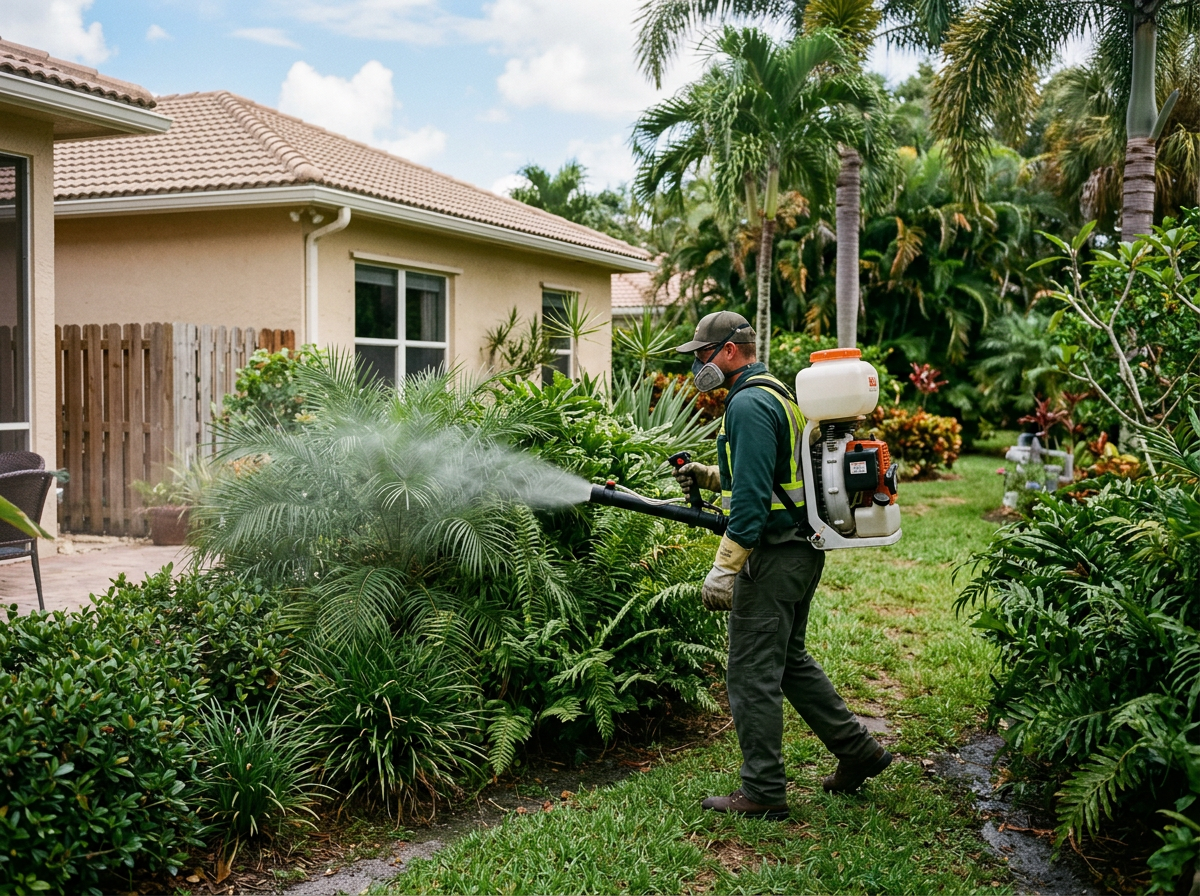
Effective work starts with a full property survey that maps every water-holding container and shaded resting area. Larvicide is placed in water that cannot be emptied, while source reduction removes or alters the containers themselves. Barrier treatments are applied to the underside of foliage where adults rest during the day rather than to open turf. Because rain washes material away, reapplication timing must account for storm frequency rather than a fixed calendar.
Mosquito Control Near You — Choose Your City
Every city below has its own local Mosquito Control page with coverage details.
Polk County
Lee County
Citrus
Brevard
Polk
Putnam County
Indian River County
Alachua
Lake
Sumter County
Sumter
Hamilton County
Levy
Bradford County
Hillsborough County
Lake County
Flagler County
Volusia County
Palm Beach County
Collier County
Citrus County
Union County
Marion
Putnam
Levy County
Brevard County
Monroe County
Martin County
Hillsborough
Nassau
Gilchrist
Orange County
Suwannee County
Marion County
Hernando County
Monroe
Bradford
Treatments fail when homeowners continue to maintain plant saucers or leave tarps with pooled water near the house. Salt-marsh mosquitoes ignore yard barriers entirely, so coastal or low-lying Brooksville lots need separate attention to influx patterns. No single visit eliminates the problem; consistent follow-up every two to three weeks during peak summer months is required to keep numbers down.
Screening does not stop no-see-ums, so properties with lanais or pool cages often need additional perimeter work along the structure edges. The practical limit is reduction, not elimination, because new adults emerge from untreated neighboring yards and marshes every week.
Technician insight
In Brooksville the thing that catches most people out with Mosquito Control is how fast afternoon storms refill every saucer and tarp they forgot about behind the shed. We see the same houses every summer where the survey turns up twenty new breeding spots because the homeowner only emptied what they could see from the patio. The salt-marsh influx from the coast also surprises inland lots that have no standing water of their own.
Brooksville yard with repeated dusk biting
The property had been treated before yet biting continued at sunset. The survey found water in bromeliads along the fence and a tarp over a boat that held several inches after each storm. Larvicide was placed in the bromeliads, the tarp was adjusted, and barrier material was applied to the lower foliage. Follow-up visits every two weeks kept new adults from establishing.
Mosquito Control Services We Offer
✓Property Breeding-Site Survey
Technicians walk the entire lot and document every bromeliad, gutter, saucer, tarp, and rain barrel that can hold water within feet of the house.
✓Barrier Treatment
Material is applied directly to the underside of shrubs, trees, and ornamental foliage where mosquitoes rest during daylight hours.
✓Larvicide Application
Targeted products are placed in water that cannot be removed, such as bromeliad tanks and permanent low spots, to stop larvae before they become adults.
✓Recurring Seasonal Service
Scheduled visits every two to three weeks maintain pressure on new hatches and account for daily storm resets common in central Florida.
✓Post-Storm Reapplication
After heavy afternoon rains refill containers, crews return to retreat washed foliage and refresh larvicide in active breeding sites.
✓Special Event Treatment
A focused barrier application is timed one to two days before outdoor gatherings to reduce biting pressure on the day of the event.
How it works
- 1
Initial Survey
A technician inspects every potential breeding container and shaded resting area on the property, noting gutters, bromeliads, saucers, and boat covers.
- 2
Source Reduction
Clients are shown which containers can be emptied, covered, or removed so new larvae have fewer places to develop.
- 3
Larvicide Placement
Water that must remain is treated with larvicide to interrupt the life cycle at the source.
- 4
Barrier Application
Product is applied to the underside of foliage and vegetation where adults rest, not to open lawn.
- 5
Follow-Up Cadence
Return visits are scheduled every two to three weeks to address new hatches and rain resets.
Pricing
Pricing is determined after an on-site inspection that accounts for lot size, number of containers, and vegetation density; call to schedule the visit.